
TL;DR
- Top students do not simply study more. They study smarter using active recall and spaced repetition instead of passive re-reading.
- The 8-8-8 rule for students, 8 hours of school or study, 8 hours of sleep, and 8 hours of personal time, is a useful framework for sustainable academic performance.
- Consistency beats cramming. A repeatable routine makes it easier to review before exam week instead of trying to relearn everything at the last minute.
- The 10-minute rule is one of the fastest ways to beat procrastination: commit to just 10 minutes of work, and momentum often does the rest.
- AI study tools like Cramd's AI flashcard generator let you apply active recall and spaced repetition without spending hours making materials from scratch.
Introduction
You have probably looked at that one student in class, the one who seems calm, gets everything turned in early, and walks out of every exam relaxed, and wondered what they know that you do not.
Here is the truth: they probably do not have a higher IQ. They have a better system.
Research consistently shows that self-regulation, study habits, and motivation play a major role in academic performance, beyond raw intelligence. The students at the top of the class are not usually grinding for 12 hours a day. They have figured out how to make every hour count, how to manage their energy, and how to study in a way that actually makes information stick.
This guide covers exactly what those students do differently, from their daily routines and study methods to the mindset shifts that separate A+ students from everyone else. Whether you are in high school or college, whether you are trying to hit a 4.0 GPA or finally get that A in organic chemistry, this is the playbook.

Quick Answer: How Do You Become a Top Student?
To become a top student, focus on active recall, spaced repetition, consistent study blocks, sleep, and practice problems. The goal is not to study longer, but to make every study session test your memory, reveal gaps, and build consistency before exam week.
A simple five-step version looks like this:
- Turn notes into questions instead of only re-reading them.
- Review material on a spaced schedule before you forget it.
- Study at consistent times so starting feels automatic.
- Protect sleep because memory consolidation depends on recovery.
- Use practice problems and mistake reviews to find weak spots early.
That is how to be a top student in a practical sense: build a system that makes good studying easier to repeat.
What Separates the Top Students?
They Prioritize Quality Over Hours
Most students think the path to straight A's means studying more. Top students know it means studying better.
Research on retrieval practice consistently shows that students remember more when they test themselves instead of only rereading. In other words, the method matters. Four focused hours of active recall studying, practice questions, and error review can beat eight distracted hours of highlighting and scrolling between tabs.
They Have Systems, Not Willpower
Students at the top of the class do not rely on motivation. Motivation is inconsistent. Instead, they build systems: fixed study times, pre-study rituals, structured review schedules, and clear goals for each session.
One habit-formation study found an average of 66 days for a behavior to become automatic, though the range varied widely from 18 to 254 days. The lesson is not that every habit takes exactly 66 days. The lesson is that consistency compounds, and getting started becomes easier when your routine is predictable.
They Use Retrieval Practice, Not Passive Review
Re-reading your notes feels productive. It usually is not enough.
Passive revision techniques like highlighting and rereading can create a false sense of mastery because the material looks familiar. Retrieval practice, forcing your brain to recall information without looking at notes, is what actually strengthens access to the memory you need during exams.
Flashcards, practice problems, blank-page brain dumps, and self-testing all count.
How to Study Smarter: The Core Methods Top Students Use
Active Recall: The Engine Behind Straight A's
Active recall is the practice of deliberately pulling information out of your memory rather than re-reading it. Studies by Roediger and Karpicke helped establish retrieval practice as one of the strongest alternatives to passive review, and the science has stayed remarkably consistent: testing yourself improves long-term learning.
The method is simple:
- Study a concept.
- Close your notes.
- Write down or say everything you remember.
- Check what you missed.
- Review those gaps and test again later.
This is what Cramd's AI flashcard generator automates for you. Upload your notes or PDF, and it generates a testable deck instantly. Instead of spending 40 minutes making flashcards, you spend 40 minutes actually drilling them.
Spaced Repetition: Do Not Re-Study, Re-Time
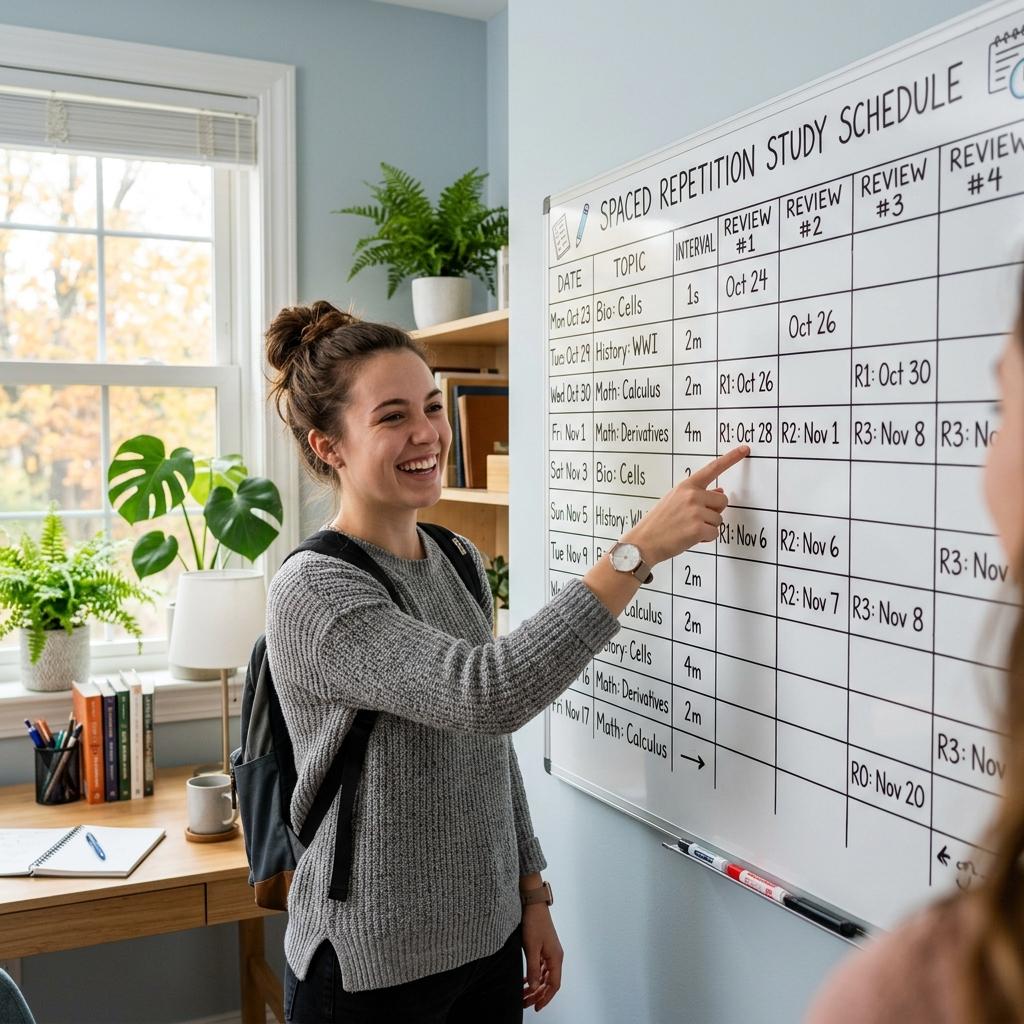
Spaced repetition is the strategy of reviewing material at increasing intervals over time. Instead of studying a topic once and hoping it sticks, you revisit it before it fully fades.
A basic schedule looks like this: review on Day 1, then Day 3, then Day 7, then Day 14. The intervals widen as the material gets stronger in your memory. Cramd's spaced repetition app handles the scheduling automatically so you review the right cards at the right time.
The Feynman Technique: Teaching as Testing
If you can explain a concept simply, you actually understand it. If you cannot, you do not, regardless of how many times you have read the chapter.
Pick any topic and try to explain it out loud as if you are teaching someone who has never heard of it. Every gap in your explanation is a gap in your understanding. Go back, fill that gap, then try again. This is one of the fastest ways to diagnose what you do not actually know.
What Is the 8-8-8 Rule for Students?
The 8-8-8 rule divides your 24-hour day into three equal blocks: 8 hours of study or school, 8 hours of sleep, and 8 hours of personal time. The idea traces back to Robert Owen's slogan: "Eight hours labour, eight hours recreation, eight hours rest."
For students, it translates directly.
8 hours of focused academic work covers class time, studying, assignments, and reviewing notes. The key word is focused. Scrolling between tasks does not count.
8 hours of sleep is not optional. Sleep is when your brain consolidates what you studied. Skimping on it can wipe out the gains from otherwise strong study sessions.
8 hours of personal time covers meals, exercise, social connection, hobbies, and rest. Students who treat this as leftover time burn out. Students who protect it stay consistent across the semester.
The 8-8-8 rule is not about perfection. Some weeks your study block runs heavy. Some nights you stay up late. The goal is to keep returning to balance, not to achieve it perfectly every single day.
What Is the 10-Minute Rule in School?
The 10-minute rule has two very different applications in school, and both are useful to know.
The Homework 10-Minute Rule
The National PTA and National Education Association commonly reference 10 minutes of homework per night per grade level. A 6th grader gets about 60 minutes. A 12th grader gets about 120 minutes. This is meant as a guide for homework load, not a cap on how much ambitious students may choose to study.
The Productivity 10-Minute Rule
This one is for your study sessions. The 10-minute rule for productivity says: when you do not want to start studying, commit to exactly 10 minutes of focused work. Set a timer. After 10 minutes, you can stop if you want.
Most people do not stop. Once you have overcome the initial resistance and built momentum, continuing often feels easier than stopping.
Pair it with Cramd's AI study tools for students: open your deck, commit to 10 minutes of flashcard review, and you will often keep going past the timer.

How to Get an A+ Grade Consistently
Front-Load Your Understanding
Do not wait until exam week to understand the material. Do the hard cognitive work during class and in the first review after. When exam week arrives, you should be reinforcing what you already know, not learning it for the first time.
This means asking questions in class, reviewing notes the same day, and using tools like Cramd's PDF summarizer to process dense readings quickly after you do them.
Use Practice Problems as Your Primary Study Method
For technical subjects like math, economics, chemistry, or biology, working through problems is more valuable than re-reading theory. Do not just check your answers. Annotate each step. If you got it wrong, write out exactly why.
Mistakes are not proof that you are bad at the subject. They are a map of what to fix before the exam.
Build Micro-Goals Into Every Session
Studying without specific targets leads to drift. Before every session, write two or three concrete things you will finish:
- Summarize Chapter 4 from memory.
- Complete 20 flashcards on the nervous system.
- Redo every missed problem from last week's quiz.
After the session, check them off. Top students make progress visible.
Stay Consistent, Not Just Intense
Short, consistent sessions compound. A 90-minute study block five days a week usually beats a 10-hour Saturday cram because your brain gets repeated retrieval practice, spaced exposure, and time to consolidate.
This is one of the most important study habits of top students: they do not wait for panic to make studying feel urgent.
What Are the Top 3 Students Called?
Academic honors for top students vary by level, but here is how the ranking system usually works.
In high school: The student with the highest GPA in the graduating class often earns the title of Valedictorian and traditionally delivers the commencement address. The second-highest GPA often goes to the Salutatorian, who may give opening remarks. Many high schools also award Latin honors: Summa Cum Laude, Magna Cum Laude, and Cum Laude.
In college: Most universities use the Latin honors system at graduation. Summa Cum Laude means "with highest honor," Magna Cum Laude means "with great honor," and Cum Laude means "with honor." The exact GPA cutoffs or class-percentile rules vary by school.
Being valedictorian requires more than just grades. It takes consistency across years. But the study habits in this post are exactly what it takes to compete for those spots.
Study Tools That Give You an Edge
Top students do not just use better methods. They use better tools. AI study tools built for students can reduce the busywork between "I have notes" and "I can test myself on this."
Cramd pulls everything together:
- AI flashcard generator: paste your notes, get a study deck in seconds.
- PDF summarizer: turn long readings into structured, testable summaries.
- Video summarizer: extract key ideas from lecture recordings.
- Spaced repetition built in: automatically shows you what to review and when.
Instead of spending your study time making materials, you spend it learning them.

Conclusion
Getting straight A's is not about studying harder. It is about building the right system and sticking to it. Active recall over passive re-reading. Spaced repetition over cramming. Consistent daily sessions over all-night grinds. A balanced 8-8-8 schedule over burning out by midterms.
You do not need to study like a machine. You need to study like someone who understands how the brain actually learns.
Start with one change: today, after class, close your notes and write down everything you remember. That is active recall. That is the top-student mindset in action.
If you want to put spaced repetition and active recall on autopilot, try Cramd free. Upload your notes, generate a deck in under a minute, and start drilling. Your next exam will feel different.