
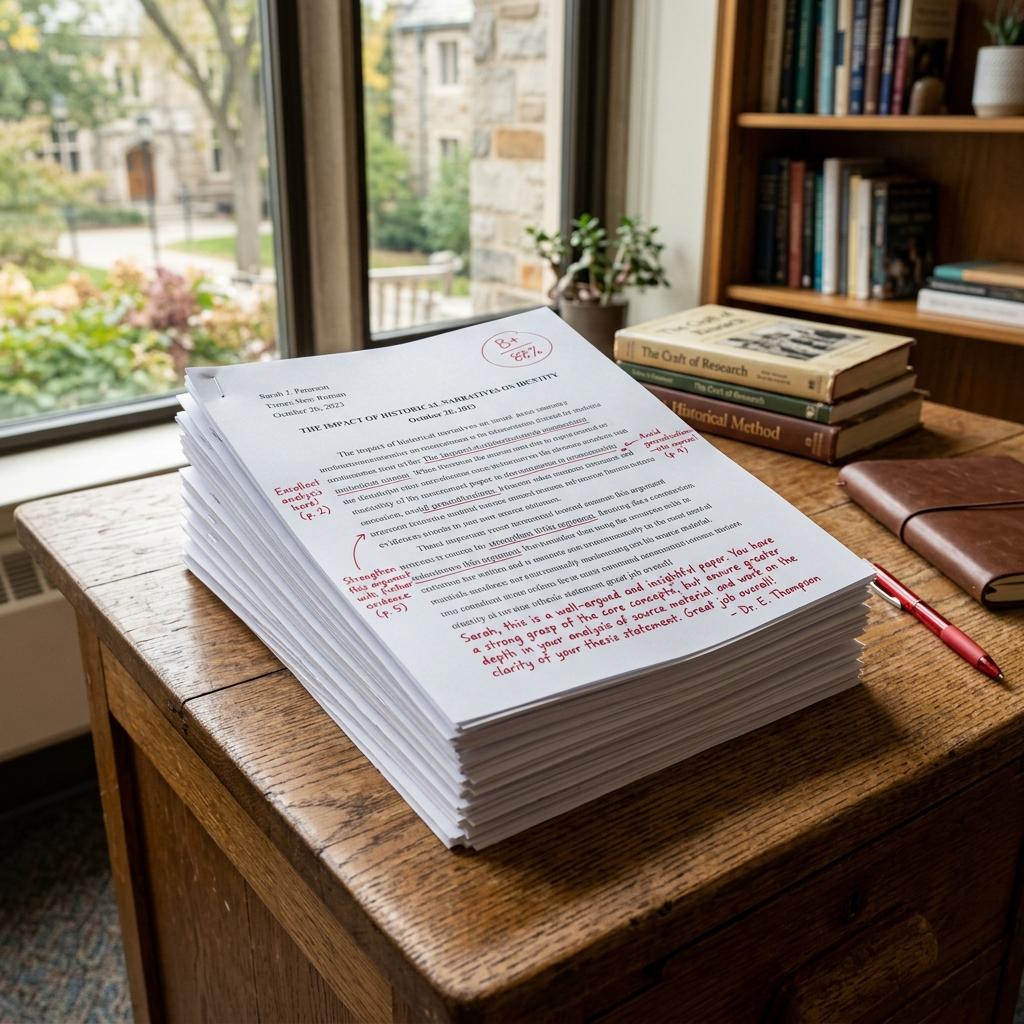
You've just assigned 35 essays. They're due Friday. You teach three sections. A typical high school English teacher spends 20 to 30 minutes grading a single essay, which means you're looking at 17+ hours of work before the weekend. That's not grading. That's a second job.
AI essay graders exist to fix that math. And in 2026, they've gotten sharp enough to actually deliver. Whether you're a teacher buried in submissions or a student who wants feedback before you hit submit, this guide walks you through exactly how an AI essay grader works and breaks down the 8 best essay grader AI tools you can use right now.

TL;DR
- AI essay graders save serious time: They can score and comment on full class sets in minutes instead of hours.
- Modern tools go beyond grammar: The best platforms evaluate thesis clarity, structure, evidence, coherence, and prompt fit.
- Different tools serve different users: Teachers usually need rubric alignment and LMS integrations, while students benefit most from revision feedback and study support.
- Human review still matters: AI is strong on consistency and speed, but weak on creative risk, context, and unusual writing choices.
What Is an AI Essay Grader?
An AI essay grader is software that reads a written essay and automatically generates a score, detailed feedback, or both. Unlike a grammar checker, which flags typos and comma splices, an AI grading tool evaluates the full picture: argument quality, structure, vocabulary, coherence, and whether the essay actually answers the prompt.
The field has a longer history than most people expect. Automated Essay Grading (AEG) as a discipline stretches back to the 1960s. The first system, Project Essay Grade, used measurable surface properties to approximate a score. Today's tools use transformer-based language models and are trained on millions of human-scored essays.
Who Uses AI Essay Graders?
Two groups get the most out of these tools:
Teachers and educators use them to grade entire classes in minutes, maintain rubric consistency across 30+ students, and reclaim planning time. Platforms like EssayGrader and CoGrader integrate directly with Google Classroom and Canvas so grading workflows do not require starting from scratch.
Students use them as a second reader before submission. Running a draft through an automatic essay grader surfaces structural weaknesses and argument gaps while there is still time to revise. It is the kind of feedback you would want from a writing center tutor, available at midnight.
How Does an AI Essay Grader Actually Work?
Modern automatic essay graders stack three technologies to produce scores and feedback.
Natural Language Processing (NLP)
NLP is the foundation. The AI reads your essay the way a linguist might, examining vocabulary range, sentence structure, grammar patterns, and argument flow. It goes past spell-check to understand context: does your word choice match the tone of the prompt? Does your thesis show up where it should?
Some tools also run sentiment analysis to check whether the essay's tone aligns with the subject matter.
Machine Learning and Training Data
AES systems train on large datasets of human-scored essays. Algorithms, from linear regression to deep neural networks, learn which essay features predict high scores by comparing thousands of graded examples. The system develops a model of what good looks like, then applies that model to new submissions.
Modern tools use transformer architectures, the same class of model behind large language models, to encode full essays into dense representations that capture both local grammar patterns and global coherence.
Rubric-Based Scoring
The third layer is rubric alignment. Raw NLP outputs get mapped against a scoring rubric, either a pre-built one or a custom rubric that a teacher uploads. This is where AI grading tools go from generic feedback generators to classroom-ready graders. The rubric anchors the AI's evaluation to actual standards, whether that is Texas STAAR, Common Core, or a teacher-built assignment rubric.
What Does an AI Essay Grader Actually Evaluate?
A good essay grader AI looks at multiple dimensions simultaneously:
- Thesis clarity: Is there a clear central argument?
- Structure and organization: Does the essay follow a logical progression?
- Evidence and support: Are claims backed up?
- Grammar and mechanics: Spelling, punctuation, syntax
- Vocabulary and style: Word choice, sentence variety, register
- Prompt adherence: Does the essay answer the actual question?
AI provides up to 45 times more feedback than traditional grading on the same assignment and delivers it in under a minute compared to the 15+ hours a teacher might spend on a full class set. The consistency alone is a major win: unlike human graders, AI does not get tired on essay 28 of 35.
8 Best AI Essay Grader Tools in 2026
1. Cramd - Best for Students Turning Feedback Into Learning
Best for: Students who want to go beyond a grade and actually remember what they learn
Cramd takes a different approach from teacher-facing graders. Where most tools hand you a score and some comments, Cramd turns your written material into flashcards, quizzes, and study guides you can actually review, so feedback becomes retention. Upload your essay draft, essay prompt, or rubric, and Cramd's AI pulls out the key concepts and weak spots, then builds study materials around them.
If your professor marks you down for misunderstanding a concept, Cramd helps you actually fix that gap instead of just noting it. Its AI flashcard generator and PDF summarizer are already used by students across writing-heavy courses to close feedback loops fast.
Key features: AI-generated flashcards from essay content, concept extraction, spaced repetition for review, PDF upload support
Free plan: Yes
2. EssayGrader - Best Overall for Teachers
Best for: ELA teachers managing large class sets who need rubric-aligned, fast grading
EssayGrader earned the top spot in an independent expert review of AI grading tools for 2026, and the teacher reviews back it up. The platform lets you build a rubric from a template, upload an entire class of essays, and receive detailed scores and student-facing feedback in minutes. Teachers report saving 5 to 6 hours per week once they dial in their rubric.
It integrates with Google Classroom, Canvas, and Schoology, includes an AI detection feature, and offers a free plan covering 25 essays per month or 400 per school year. Over 100,000 teachers across 1,000+ schools use it.
Key features: Custom rubrics, bulk upload, LMS integration, AI writing detection, standards alignment (CCSS, STAAR, Florida BEST)
Free plan: Yes (25 essays/month)
3. CoGrader - Best for Google Classroom Integration
Best for: Teachers already living inside Google Classroom
CoGrader connects directly to Google Classroom, Canvas, and Schoology, pulling student submissions automatically and returning feedback without requiring extra uploads. Its AI generates rubric-aligned scores and detailed justification reports for each student. Teachers review and adjust before finalizing, so the AI accelerates the workflow without removing educator judgment.
The platform claims to reduce grading time by 80%. Its AI detection feature is available on School/District subscriptions and flags potentially AI-generated content to inform follow-up conversations.
Key features: Native Google Classroom integration, rubric-based grading, student-level feedback reports, AI detection (school tier)
Free plan: Yes
4. Gradescope (by Turnitin) - Best for Universities and STEM
Best for: University instructors grading at scale across STEM and humanities
Gradescope was built for higher education. It handles everything from essay PDFs to programming assignments to bubble sheets, making it one of the most flexible platforms on this list. Its AI answer grouping clusters similar student responses so you can apply feedback to a whole group at once, which makes large-enrollment courses manageable.
Because it is a Turnitin product, plagiarism detection is built in. It integrates with Canvas, Blackboard, Brightspace, Moodle, Sakai, and more. Institutional pricing means it is typically not a tool individual teachers can buy independently.
Key features: Multi-format grading, AI answer grouping, Turnitin plagiarism detection, LMS integration, analytics
Free plan: Free basic plan for instructors
5. Turnitin Feedback Studio - Best for Academic Integrity
Best for: Institutions where academic integrity is the primary concern
Turnitin Feedback Studio serves 34 million students and 15,000 institutions across 80 of the top 100 universities globally. Its plagiarism detection compares submissions against the world's largest database of academic papers, web content, and prior student submissions. The Feedback Studio layer adds grading tools, inline commenting, and data analytics on top.
It is not the fastest or most accessible tool for individual teachers, but for institutions that need defensible, consistent academic integrity infrastructure alongside grading, nothing else at this scale compares.
Key features: Industry-leading plagiarism detection, inline feedback, grade analytics, AI writing detection, LMS integration
Free plan: No, institutional pricing
6. Smodin - Best for Multilingual Classrooms
Best for: Teachers working with English language learners or international students
Smodin combines essay grading with rewriting assistance, plagiarism detection, AI content detection, and multilingual support under one roof. Its essay grader assigns a percentage score alongside dimensional feedback on structure, argument, and grammar, giving students a concrete reference point before submission.
The rewrite mode suggests specific passage improvements, and the platform's language support makes it one of the few options well-suited to classrooms where English is not every student's first language.
Key features: Multilingual grading, percentage scores, AI detection, plagiarism checking, rewrite mode
Free plan: Yes (limited)
7. Kangaroos AI - Best for Bulk Processing
Best for: Districts or administrators grading at very high volume
Kangaroos AI leans into scale. Its bulk upload feature handles large batches of essays simultaneously, and its library of AI tools extends beyond grading into a broader set of educator-facing utilities. Custom rubrics, AI-generated feedback, and a summarizer for quick essay overviews round out the feature set.
It is a heavier-duty option than classroom tools like CoGrader, better suited to district-level operations or testing scenarios where volume is the primary constraint.
Key features: Bulk essay upload, customizable rubrics, AI detection (upcoming), summarizer, extensive AI tools library
Free plan: Check site for current plans
8. NoteGPT AI Grader - Best Free No-Login Option
Best for: Students who need fast feedback with no account required
NoteGPT's AI Grader is the zero-friction option on this list. No account, no sign-up. Paste your essay, hit grade, and get feedback in seconds. It evaluates grammar, tone, and structure using NLP and machine learning, and it handles text uploads, typed input, and image submissions.
It is not built for institutional use, but for a student who needs a quick sanity check before submitting a draft at 11 p.m., it is hard to beat the accessibility.
Key features: No sign-up required, handles multiple input formats, fast feedback, suitable for all education levels
Free plan: Fully free
Comparison Table
| Tool | Best For | Free Plan | LMS Integration | AI Detection |
|---|---|---|---|---|
| Cramd | Students - feedback to retention | Yes | No | No |
| EssayGrader | ELA teachers, bulk grading | Yes (25/mo) | Yes | Yes |
| CoGrader | Google Classroom users | Yes | Yes | School tier |
| Gradescope | Universities, STEM | Yes (basic) | Yes | Yes (Turnitin) |
| Turnitin Feedback Studio | Academic integrity | No | Yes | Yes |
| Smodin | Multilingual classrooms | Yes (limited) | No | Yes |
| Kangaroos AI | High-volume districts | Check site | No | Upcoming |
| NoteGPT AI Grader | Quick student feedback | Fully free | No | No |

Can AI Replace Human Graders?
No, and the best tools do not try to. An automatic essay grader can process 35 essays in the time it takes you to grade one. It never gets tired on essay 28. But it also cannot evaluate creative risk-taking, recognize a student's intellectual leap, or factor in context that a rubric does not capture.
As NYU Professor of Philosophy Kwame Anthony Appiah put it in a New York Times column on the topic, the time AI saves could be better spent on what actually matters: one-on-one instruction, targeted feedback conversations, and the parts of teaching no algorithm can replicate.
The best approach is to use AI to handle the mechanical layer of grading, then direct your attention to the students who need you most.
How to Choose the Right AI Grading Tool
Your answer depends on who is using it:
If you're a student: Use Cramd to turn feedback into active study, or NoteGPT for zero-friction quick checks before you submit.
If you're a teacher with Google Classroom: CoGrader is the smoothest integration. EssayGrader gives you more rubric flexibility and free-tier volume.
If you're at a university: Gradescope handles multi-format assignments at scale. Turnitin Feedback Studio is the move if your institution already uses Turnitin.
If your classroom includes ELLs or international students: Smodin's multilingual support helps close that gap.
A tip from edtech experts: run grammar tools and argument-checking tools separately. Most grammar checkers and argument or structure graders address different problems. Use both, not just the one you are more comfortable with.
Use AI Feedback to Actually Study Smarter
Getting a score is one thing. Improving from it is another.
Most students glance at the feedback, note the grade, and move on. The students who actually improve are the ones who practice active recall on the concepts they got wrong, not just re-read their marked-up essay.
Cramd's AI study tools let you upload your essay, notes, or professor's feedback and generate flashcards and quizzes around the material. That turns a one-time grade into a study session. If you are working on writing-intensive courses and want a tool that connects feedback to actual retention, it is worth trying.
You can also pair it with Cramd's text summarizer to break down complex rubric criteria into digestible study points, so you know exactly what to focus on next time.

The Bottom Line
An AI essay grader does not replace the thinking behind good writing. It handles the repetitive pattern-matching layer of assessment so teachers can focus on instruction and students can fix problems before they submit.
The tools on this list cover every use case, from a free no-login check at midnight to a district-wide grading infrastructure. Pick the one that fits your workflow, not the flashiest option.
And if you're a student who wants feedback that actually leads somewhere, try Cramd free. Upload your essay draft, generate flashcards from the concepts you're missing, and review them with spaced repetition before the next assignment drops.
That is how you go from a grade to actual improvement.