
TL;DR
- One bad exam does not automatically destroy your GPA. The real damage depends on how much that exam weighs in your final course grade and how many total credit hours you have already completed.
- GPA is a cumulative average. The more strong grades you already have, the less a single poor result can move the needle.
- One B on a strict unweighted 4.0 scale does end the perfect 4.0. That matters mathematically, but it is rarely a make-or-break outcome in practice.
- A 2.5 GPA in 9th grade is a warning sign, not a dead end. You still have time to build a strong upward trend before college applications.
- The best fix is studying smarter, not longer. Active recall and spaced repetition beat passive cramming.
Introduction
You just bombed a final. Or maybe you got a B when you needed an A. Now you are spiraling, wondering if one grade just wrecked your GPA and your future with it.
Take a breath. In most cases, one bad exam will not ruin your GPA. But the real answer depends on the math behind your course grade, your cumulative credits, and how much academic history you already have.
Whether you are a high school freshman staring at a 2.5 GPA and wondering if college is still possible, or a college student trying to recover from one brutal midterm, this guide breaks down how GPA math actually works, what one bad grade really costs you, and what to do next so the next exam goes differently.
How GPA Is Actually Calculated (And Why Context Changes Everything)
Before you can judge the damage from a bad exam, you need to understand the math behind GPA.
The Basic Formula
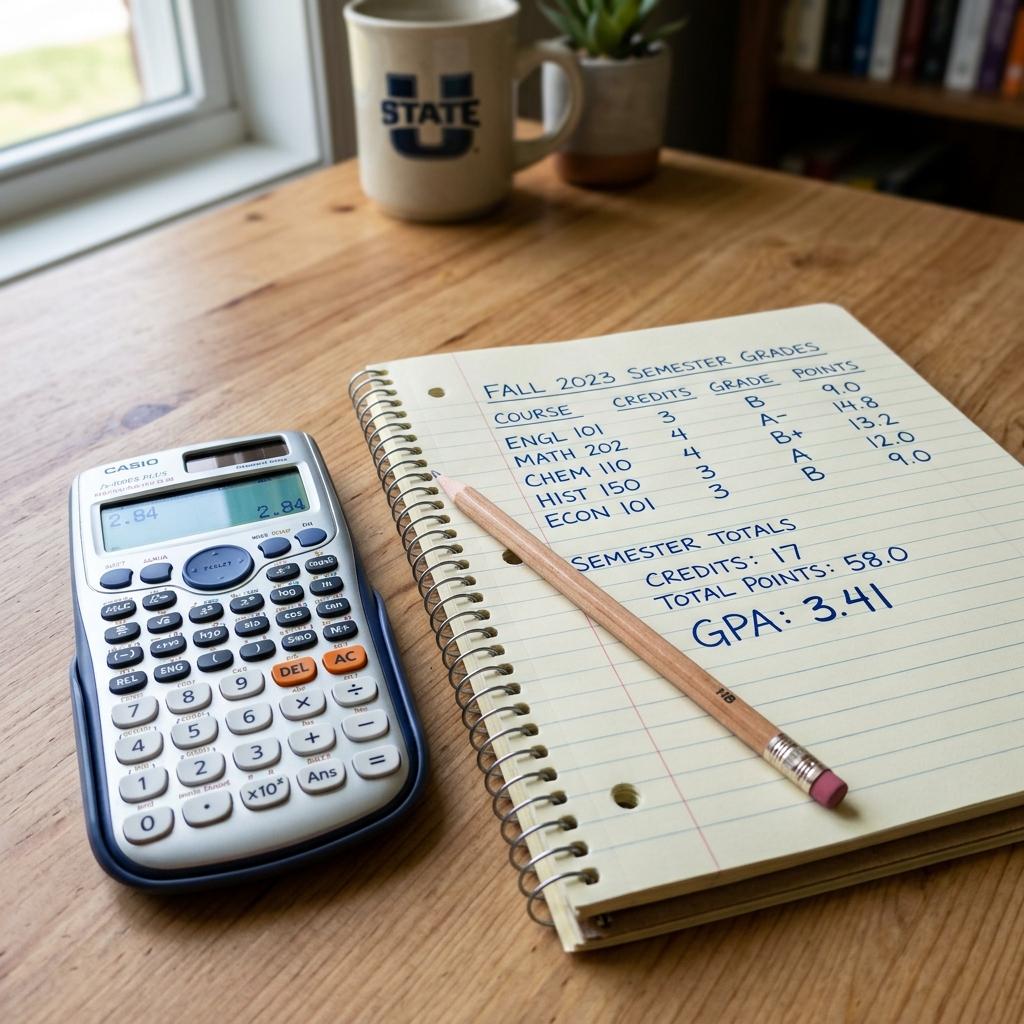
Your GPA is your total grade points divided by your total credit hours attempted. In a common unweighted system, letter grades map to point values like this:
- A = 4.0
- B = 3.0
- C = 2.0
- D = 1.0
- F = 0.0
A course worth more credits has more influence than a lighter elective. Stanford's student services office explains the process clearly: multiply the grade-point value by the course credits to get quality points, then divide total quality points by total attempted credits.
Why More Credits Means More Protection
If you have only completed 15 credit hours, one rough 3-credit class can move your GPA a lot. If you have already completed 90 credit hours, the exact same class has much less power over your cumulative average.
That is why freshmen often see their GPA swing faster than juniors and seniors. More completed credits create a dilution effect. Every new course matters, but no single course has the same leverage once your transcript is longer.
The Difference Between an Exam Grade and Your GPA
A bad exam does not hit your GPA directly. First, it affects your course grade. Then your course grade gets converted into grade points at the end of the term and folded into your cumulative GPA.
So the real chain looks like this:
- You score poorly on an exam.
- That exam changes your course average based on its syllabus weight.
- Your final course grade converts into GPA points.
- That course gets blended into your full transcript.
That is why exam weight matters so much. GradeCalculator's FAQ notes that an assessment's impact is proportional to its weight. A final worth 10% is annoying. A final worth 50% can completely reshape the course outcome.
Will One B Ruin a 4.0 GPA?
Short answer: mathematically, yes. Practically, it depends on what you mean by "ruin."
On a Strict Unweighted 4.0 Scale
If your school uses a strict unweighted 4.0 scale and does not allow grade replacement, one B drops your cumulative GPA below 4.0 and keeps it there.
If you have 10 completed courses with all A's, you have 40 total grade points. Add one B, and you now have 43 points across 11 courses:
43 / 11 = 3.91
That is still a very strong GPA. The perfect 4.0 is gone, but your academic profile is still excellent.
On a Weighted Scale
Many high schools use weighted systems for AP, IB, or Honors classes. In that world, a single B does not always destroy an overall weighted average above 4.0.
CollegeVine explains that weighting changes how rigor is reflected in GPA. A B in a demanding AP class can land very differently from a B in a standard elective.
What Colleges and Employers Actually See
For most admissions teams and employers, one B on an otherwise strong transcript reads as normal, not catastrophic. CollegeVine's college admissions guidance emphasizes context, consistency, and trend much more than one isolated data point.
The bigger danger is not the B itself. It is letting the panic around one grade throw off the rest of your semester.

Is a 2.5 GPA Bad for a 9th Grader?
Yes, a 2.5 GPA is below average. No, it is not a dead end.
What a 2.5 GPA Actually Means
The national GPA average is usually around 3.0. A 2.5 often reflects a mix of C-range work with some stronger and weaker classes mixed in. GPAcalculator.net notes that a 2.5 puts a freshman below the national average, but that does not mean recovery is unrealistic.
Why 9th Grade Still Counts
Freshman grades matter. GreatSchools.org points out that most colleges do review 9th-grade performance, even if a few systems recalculate GPA differently later.
That said, trend matters too. A student who starts with a 2.5 and then climbs each year tells a much better story than a student whose grades slide over time.
What to Do If You Are a Freshman With a 2.5
PrepScholar's breakdown makes the key point: a 9th grader still has time. The move now is not vague panic. It is identifying the classes pulling you down and changing the study system behind them.
Even a 0.3 to 0.5 GPA improvement per semester can change your options dramatically over the next few years if you build better habits early.
How Much Can One Bad Semester Really Move Your GPA?

This is where the math starts to feel a lot less scary.
The Dilution Effect
College Refocus puts it plainly: strong semesters that follow a weak one gradually dilute the damage.
Say you have completed 60 credit hours with a 3.5 GPA. That equals 210 quality points.
If you then have one rough 15-credit semester at a 2.0 average, that adds 30 quality points:
- Before:
210 / 60 = 3.5 - After:
(210 + 30) / (60 + 15) = 240 / 75 = 3.2
Painful, yes. Permanent, no.
If the next 15-credit semester is a 3.8 average, you add 57 more quality points:
- Recovery:
(240 + 57) / 90 = 297 / 90 = 3.3
That is the core GPA lesson: future strong semesters keep pushing the average back up.
The Exam Weight Problem
Where students get blindsided is not always GPA math. It is course-weight math.
If a final exam is worth 40% of your grade and you bomb it, you can slide from a B+ to a D in that class. That is a much bigger GPA hit than losing a few quiz points. If you want the detailed course-grade side of the math, our post on do final exams hurt your grade breaks down the weighted-grade formula step by step.
The University of Utah's GPA guide is also a useful reference for understanding how credit-weighted grades stack up over time.

How to Recover - And Prevent It From Happening Again
One bad grade is a signal, not a sentence. What matters most is what you do after it.
Step 1: Do the Math First
Do not rely on vague dread. Run the numbers. Figure out your current GPA, how much the course is worth, and what your likely semester outcome is.
A calculator will usually calm you down faster than guessing will.
Step 2: Switch to Active Recall
Most students who underperform on exams are not always studying too little. They are often studying in ways that feel productive without building durable memory.
Research summarized by Birmingham City University supports retrieval-based study and spaced review over passive rereading. After a study session, close your notes and write or say everything you can remember. That retrieval effort is the part that strengthens memory.
If you want a deeper breakdown, start with active recall.
Step 3: Use Spaced Repetition Instead of Cramming
Cramming creates short-term familiarity. Spaced repetition builds recall that lasts long enough to survive a real exam.
One practical framework is the 2-3-5-7 revision method: review material the next day, then three days later, five days later, and again a week later. Or go deeper on the full method in our spaced repetition guide.
Step 4: Turn Your Notes Into Flashcards
Passive notes are easy to collect and easy to ignore. Flashcards force you to turn information into prompts, questions, and retrieval practice.
Cramd's AI flashcard generator can turn notes, textbook pages, or PDFs into quiz-ready cards in seconds, which makes it much easier to spend your time reviewing instead of formatting.
For finals specifically, how to make notes for final exams covers how to build revision material that actually holds up under time pressure.
Step 5: Talk to Your Advisor
Some schools offer grade replacement, late withdrawals, or academic forgiveness policies that can soften the GPA impact from one rough term.
GPAcalculators.net notes that many students overlook institutional policies that can materially change recovery options. Ask early rather than assuming you are stuck with the worst-case version.
The Bottom Line
One bad exam usually will not ruin your GPA. One bad study system can.
GPA math rewards consistency over time. The more strong semesters you stack, the less any one course can define your record. Whether you are a 9th grader trying to climb out of a 2.5 GPA or a college student trying to recover from one ugly midterm, your next few decisions matter far more than the single score you are panicking about right now.
If you want the fastest way to improve the next grade, stop rereading and start practicing retrieval. Cramd's AI flashcard generator helps you turn notes and PDFs into active recall practice quickly, so your study sessions actually prepare you for the next exam.
Frequently Asked Questions
Written by the Cramd Team. Cramd is an AI-powered study platform that helps students turn notes, PDFs, and textbooks into flashcards, summaries, and study guides fast. Start for free at trycramd.com.