You've spent hours at your desk, highlighter in hand, reading the same chapter three times. Then the exam arrives and half of it feels brand new. Sound familiar?
You're not alone. A 2025 study in the British Journal of Educational Psychology tracked 231 university students over 30 days and found that better study strategies — planning, monitoring, concentration — can compensate for less total study time when it comes to achieving daily goals. The problem for most students isn't effort. It's method.
This guide breaks down the study methods that cognitive science actually supports, how to build them into a routine, and how tools like Cramd can help you get more out of every session. Whether you're in your first semester of college or grinding through premed, these techniques work across subjects and schedules.

TL;DR
- Active Recall forces your brain to retrieve info from memory, strengthening neural pathways faster than re-reading.
- Spaced Repetition schedules your review sessions at increasing intervals, permanently interrupting the forgetting curve.
- The Pomodoro Technique structures your study time into 25-minute bursts to prevent mental fatigue.
- Create a dedicated, consistent study environment free from digital distractions (phone out of sight).
- Note-taking is useless if you don't use it to quiz yourself; try the Cornell method or blurting to maximize retention.
- You don't need to change everything at once. Start by picking one method today.
Why Most Study Methods Fail
Before getting into what works, it helps to understand what doesn't.
Re-Reading and Highlighting Are (Almost) Useless
Re-reading your notes feels productive. It's comfortable, low-effort, and creates a sense of familiarity with the material. That familiarity is a trap.
When you read something a second time, your brain recognizes the words without retrieving the meaning. A 2025 study published in ScienceDirect found that 91% of students relied on re-reading notes, textbooks, or rewatching videos as their main learning strategy. The same study found this approach creates a false sense of understanding rather than true retention, particularly in complex subjects.
Highlighting has the same problem. Unless you're going back to quiz yourself on what you highlighted, you're just painting your textbook.
The Myth of the Marathon Study Session
Sitting down for a four-hour session feels like serious effort. In practice, your focus degrades sharply after 25 to 30 minutes of sustained work without a break. You end up spending the last two hours reading words without processing them.
Research consistently shows that structured, shorter sessions with planned breaks outperform long uninterrupted blocks, both for retention and for how you feel during the work. More on that in the time management section below.
The Study Methods That Actually Improve Retention
What Is Active Recall Studying and Why Does It Work?
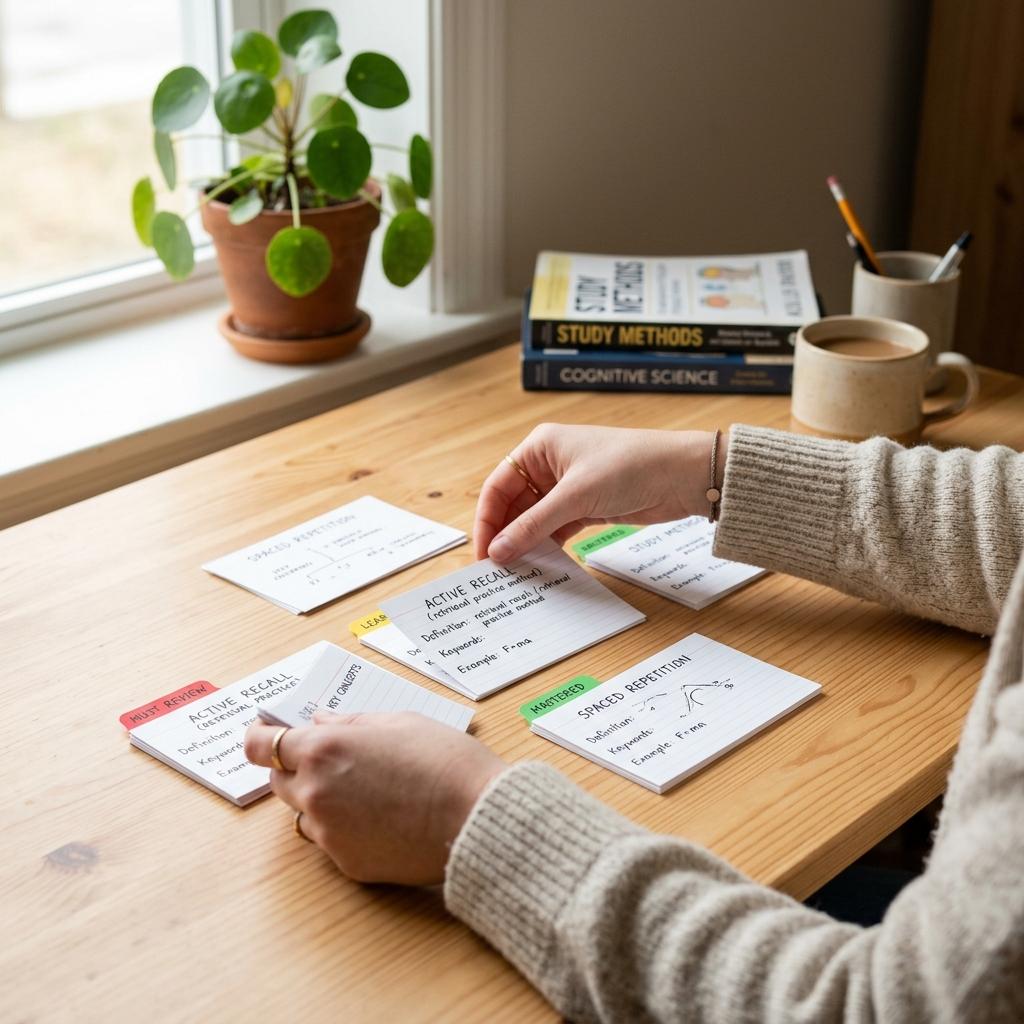
Active recall studying means retrieving information from memory instead of passively reviewing it. Instead of reading your notes, you close them and try to write down or say out loud what you remember.
A 2024 systematic review published on PubMed examined active recall strategies across higher education students and found that flashcards correlated with higher GPA and test scores, while self-testing and retrieval practice were among the most effective techniques available but remained significantly underused. The researchers noted that concept mapping also boosted student confidence, but retrieval practice produced the strongest academic outcomes.
The science behind it is straightforward. Every time your brain tries to retrieve a piece of information, it strengthens the neural pathway to that memory. Passive reading doesn't do this. Testing yourself does.
Practical ways to use active recall:
- After reading a section, close the book and write down everything you remember
- Turn your notes into questions and quiz yourself the next day
- Use the Feynman technique: explain the concept out loud as if teaching it to someone else
- Use an AI flashcard maker to generate questions from your notes automatically
The last option is worth dwelling on. Manually creating flashcards for an entire chapter takes time. Cramd's AI flashcard generator turns your notes or PDFs into ready-to-use flashcards in seconds, so you spend your time actually studying rather than formatting cards.
For a deeper look at the research behind this technique, read The Power of Active Recall.
How Does Spaced Repetition Work?
Spaced repetition is a scheduling method where you review material at increasing intervals over time. Instead of reviewing everything every day, you review things just before you're likely to forget them.
The same 2025 ScienceDirect study on pharmacy students found that combining spaced repetition with active recall produced significantly better long-term retention than traditional study methods. Notably, cramming the same material ten times within a short window, such as the night before an exam, showed little benefit for retention a week later.
A simple spaced repetition schedule looks like this: review new material on day one, then again on day three, then day seven, then day fourteen. Each time you successfully recall something, you push the next review further out. Each time you struggle, you review it sooner.
Cramd has spaced repetition built directly into its flashcard system, so the scheduling happens automatically. You don't have to track intervals yourself. For a full breakdown of how to use this method, check out Mastering Spaced Repetition.
The Pomodoro Technique: Structured Breaks, Serious Results
The Pomodoro technique splits study time into 25-minute focused intervals, each followed by a 5-minute break. After four rounds, you take a longer break of 15 to 30 minutes.
A 2025 scoping review published in BMC Medical Education examined 32 studies involving over 5,270 students and consistently found positive associations between Pomodoro-style intervals and improved task focus, time management, and reduced cognitive fatigue. A separate study comparing students who used structured breaks against those who self-regulated found that the structured group reported lower fatigue and better concentration, even when total study time was similar.
The technique works because it removes the decision fatigue of figuring out when to stop. You know the break is coming, so you can stay locked in for the 25 minutes.
One caveat: some students find the 25-minute interval too short for subjects that require deep, sustained thinking, like writing or complex problem sets. Experiment with 35 or 45-minute blocks if the standard interval keeps interrupting your flow.

How to Set Up Your Study Environment
Your environment shapes your focus before you even open a book.
Your Physical Space
You don't need a perfect setup, but a few things matter more than people realize. Good lighting reduces eye strain. A chair that isn't actively uncomfortable removes a distraction. A clear desk removes visual clutter that pulls your attention.
The bigger issue is consistency. Studying in the same spot trains your brain to shift into focus mode when you sit there. If you study in bed, your brain associates that space with rest, and focus becomes harder.
Keep your phone in another room or face-down with notifications off. A 2014 study found that the mere presence of a smartphone on a desk reduces cognitive capacity, even if you don't check it.
Digital Setup
Digital distractions are harder to remove than physical ones because they're embedded in the same device you're studying on. A few approaches that actually work:
- Use a browser extension like Cold Turkey or Freedom to block distracting sites during study sessions
- Put your phone on Do Not Disturb or use an app like Forest that discourages you from touching it
- If you're studying with Cramd, the focused flashcard interface keeps you on task without the temptation of an open browser tab
What's the Best Way to Take Notes?
Note-taking is one of the most discussed study topics and one of the most misunderstood. Taking notes isn't the same as learning. What matters is how you review them afterward.
During Class or a Lecture
Write the main ideas, not everything. Students who try to transcribe lectures word for word tend to process less of what they're hearing because their attention is on typing rather than understanding. Aim to capture the core concept of each point in your own words, and flag anything you don't understand with a question mark so you can follow up later.
The Cornell method is worth trying. You divide your page into two columns: a narrow one on the left for questions and keywords, and a wider one on the right for your notes. After the lecture, you use the left column to quiz yourself on the right column. It builds active recall directly into your note-taking system.
After Class: The 24-Hour Rule
Review your notes within 24 hours of taking them. The research on memory decay is clear: your ability to recall what you've learned drops sharply in the first day if you don't revisit it.
A quick 10-minute review the same evening, or the next morning at the latest, locks the information in before it fades. You're not re-reading. You're covering the notes and trying to recall the key points before checking.
For an in-depth look at different note-taking approaches, read What is the Best Method for Note-Taking?
How AI Study Tools Fit Into These Methods
The study methods above have strong research behind them. The challenge is that they take effort to set up consistently. AI study tools reduce the friction.
Using an AI Flashcard Maker for Active Recall
Creating flashcards manually for a 40-page reading takes time that most students don't have. An AI flashcard generator like Cramd's reads your notes or PDF and generates question-and-answer cards automatically. You get the retrieval practice benefits without the setup cost.
Upload your lecture slides or reading, and Cramd pulls out the key concepts and turns them into testable flashcards. Then the spaced repetition system handles scheduling. You show up and study.
PDF Summarizer for Dense Reading
If you're staring down a 60-page paper and need to extract the key ideas before building flashcards from them, Cramd's AI PDF summarizer breaks it down into digestible summaries in under 30 seconds. From there, you can generate flashcards directly from the summary or dig into the full text with a clearer picture of what matters.
This doesn't replace reading. It gives you a map before you enter the territory, which makes the reading itself faster and more focused.
What to Look for in a Spaced Repetition App
Not every flashcard app uses spaced repetition properly. Look for a system that adjusts review intervals based on how well you recalled each card, not one that just cycles through the deck in order. Cramd's spaced repetition is built on this adaptive model, so cards you know well appear less often and cards you struggle with come back sooner.
If you're currently using Quizlet and want to bring your existing decks over, Cramd's Quizlet import tool makes that a one-step process.
Your 7-Day Study Methods Reset
If you want to change how you study, don't try to overhaul everything at once. Add one thing per day and let it compound.
Day 1: Set up your study space. Clear the desk, charge your laptop, put your phone somewhere inconvenient.
Day 2: Create a schedule with your peak hours blocked for your hardest subject. Most people focus better in the morning, but track your own energy for a week before assuming anything.
Day 3: Try active recall on your next study session. Read a section, then close the material and write down what you remember. Check what you missed.
Day 4: Use the Pomodoro technique for one full study session. Set a 25-minute timer, work with no distractions, then take five minutes away from the screen.
Day 5: Review your notes from the past week using the Cornell method. Cover the main notes and use your left-column questions to test yourself.
Day 6: Upload a set of notes or a PDF to Cramd and let it generate flashcards. Spend 20 minutes doing a review session.
Day 7: Look back at what worked. Which sessions felt productive? Where did your attention drop? Adjust from there.
Common Mistakes Worth Avoiding
Studying without a plan means defaulting to whatever feels easiest, which is usually re-reading. Before each session, write down the specific thing you're trying to learn or be able to do. That constraint makes the session more focused.
Pulling all-nighters before exams trades short-term recognition for actual retention. You might feel ready at 2am. Six hours later, in the exam room, retrieval is harder than it was the night before because sleep is when your brain consolidates memories.
Multitasking while studying is a significant performance drain. Background noise with lyrics is harder to study with than instrumental music or silence, depending on the person. Test both, and be honest about which one actually helps.
Skipping difficult topics because they're frustrating is the fastest way to fall behind. Hard material is hard precisely because you haven't retrieved it enough times for it to stick. That's the problem active recall solves.
Start With One Thing
You don't need to implement every technique in this guide to study better. Pick one: active recall, spaced repetition, or structured breaks. Run it for a week and notice the difference.
If you want a shortcut, Cramd builds active recall and spaced repetition into a single platform, so you don't have to manage both separately. Upload your notes, generate flashcards, and let the system schedule your reviews.
The method matters more than the hours. Try Cramd free and see what changes.

Frequently Asked Questions (FAQ)
Related Reading: