
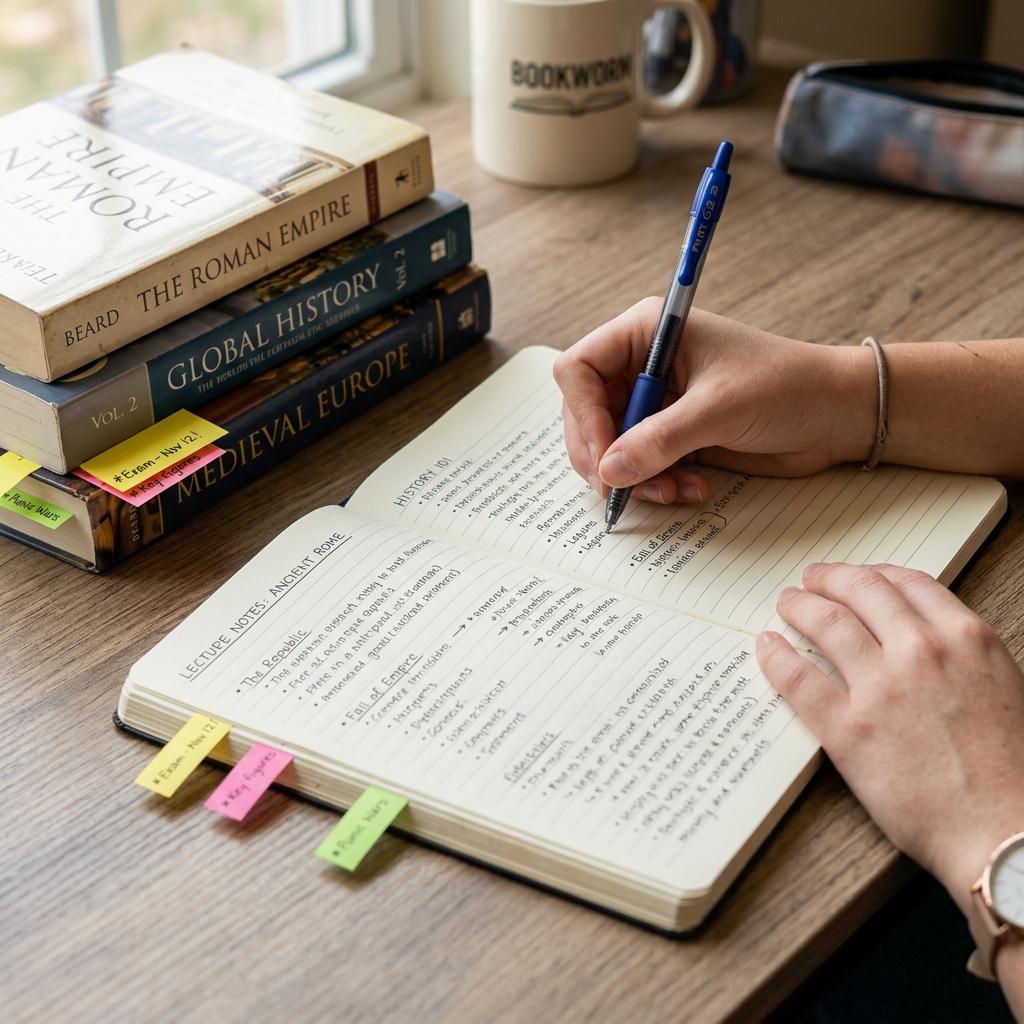
If your study routine looks like "read notes, read them again, maybe read them a third time," you're in good company. Rereading is one of the most common ways students study - in one frequently cited survey, 84% of college students reported using repeated reading as a study strategy. There's just one problem: it's also one of the least effective ways to actually learn something.
That's not an opinion - it's the conclusion of a widely cited review of learning techniques. Psychologist John Dunlosky and colleagues evaluated ten common study techniques and ranked rereading near the bottom for "utility," right alongside highlighting. So if you've ever reread a chapter three times and still blanked on the exam, it wasn't a discipline problem. It was a method problem.
The good news: fixing it doesn't mean studying longer. It means studying differently. Below are seven research-backed ways to replace rereading with techniques that actually build memory - plus the science behind why they work.
Why Rereading Notes Doesn't Work
The "Illusion of Fluency" Explained
Here's the trap: the more you reread something, the more familiar it feels, and your brain mistakes that familiarity for knowledge. Cognitive scientist Robert Bjork has described this as a byproduct of perceptual fluency - rereading makes the words on the page feel smooth and recognizable, and students confuse that smoothness with comprehension.
The problem is that recognizing information and recalling it from memory are two completely different skills. You can nod along to your notes and follow the logic perfectly, then sit down for a test and draw a blank - because recognizing a concept when it's in front of you doesn't mean you can produce it on your own.
What the Research Actually Says
The Dunlosky et al. (2013) review remains one of the most influential comparisons of common study techniques. After analyzing decades of studies, the researchers gave rereading a "low utility" rating, alongside highlighting and underlining. On the other end of the spectrum, two techniques earned "high utility": practice testing and distributed (spaced) practice.
Earlier research backs this up too. A well-known study by Karpicke, Butler, and Roediger found that most students default to rereading even when they know testing themselves works better - because rereading is easier and feels less uncomfortable. That discomfort, it turns out, is actually a feature, not a bug. Psychologists call it "desirable difficulty": the mental effort of retrieving information is exactly what makes it stick.
There's also a time-efficiency angle that rarely gets mentioned. Because rereading produces weak long-term retention, students often end up rereading the same chapter three or four times before an exam, which can add up to more time than a single focused round of self-testing. The techniques below generally take a similar time investment to rereading and tend to produce better results.
7 Ways to Study Without Rereading
1. Use a Brain Dump for Active Recall
Active recall studying is the broad principle behind everything on this list: retrieving information from memory instead of passively reviewing it. A brain dump, also called free recall, is one of the simplest ways to put that principle into practice. Instead of scanning your notes and hoping information sinks in, you close them and try to reconstruct everything you can remember on a blank page - no prompts, no outline, just your memory.
This works because retrieval itself strengthens memory. Each successful retrieval makes the information easier to access again in the future. Afterward, compare what you wrote to your actual notes. The gaps show you exactly what to study next, which is far more useful than a vague sense of "I read this already."
A simple way to start: pick one lecture or one chapter, grab a blank sheet of paper, and give yourself five minutes to write down everything you remember about it - key terms, definitions, and how ideas connect to each other. Don't worry about writing in complete sentences or perfect order. Then open your notes and circle anything you missed entirely or got wrong. Those circled items are your real study list, not the whole chapter. If you want a deeper breakdown of the mechanics, check out the power of active recall for a full walkthrough.
2. Practice Testing and Self-Quizzing
If active recall is the principle, practice testing is the workhorse. A large-scale meta-analysis found that testing generally improves learning in real classroom settings. Students who quiz themselves regularly tend to outperform students who spend the same amount of time simply rereading, though the size of that advantage varies by subject, question type, and how the practice is structured.
The format matters less than the act of retrieval itself. Past papers, end-of-chapter questions, or questions you write yourself all work. The goal isn't a perfect score - it's finding your weak spots before the real exam does. Always check your answers afterward: retrieval strengthens learning, but without feedback you risk practicing an incorrect answer until it feels right.

3. Flashcards With Spaced Repetition
Flashcards get a bad reputation as "old school," but they're really just a delivery mechanism for active recall. When flashcards require genuine retrieval - not just recognizing the answer - and are reviewed on a spaced schedule, they combine two of the techniques Dunlosky's review rated highest: practice testing and distributed practice. Instead of cramming everything in one sitting, spaced repetition schedules reviews at increasing intervals, such as a day, then three days, then a week, which matches how memory actually consolidates over time.
The catch with flashcards is that making them by hand from scratch eats up time students don't have. This is where an AI flashcard generator can help. Feeding in your notes or lecture slides and getting a testable set of cards back in seconds means you spend your study time actually recalling information instead of formatting index cards. If you want the full science behind timing your reviews, our guide to mastering spaced repetition covers it in depth.
4. The Feynman Technique
Named after physicist Richard Feynman, this method has you explain a concept out loud, in plain language, as if you were teaching it to someone with no background in the subject. No jargon, no notes to lean on.
The value here is diagnostic: the moment your explanation gets clunky or you start reaching for words you don't fully understand, you've found a gap. Feynman-style self-explanation is particularly strong for conceptual subjects with underlying principles - think physics, biology, or economics - where understanding why matters as much as memorizing what.
5. Turn Your Notes Into Questions
If you already take notes in a structured format, you're one step away from a powerful active-recall tool. The Cornell method is the clearest version of this: draw a line down your page, keep your main notes on the right side, and after class, write questions based on those notes on the left side.
6. Interleave Topics Instead of Studying in Blocks
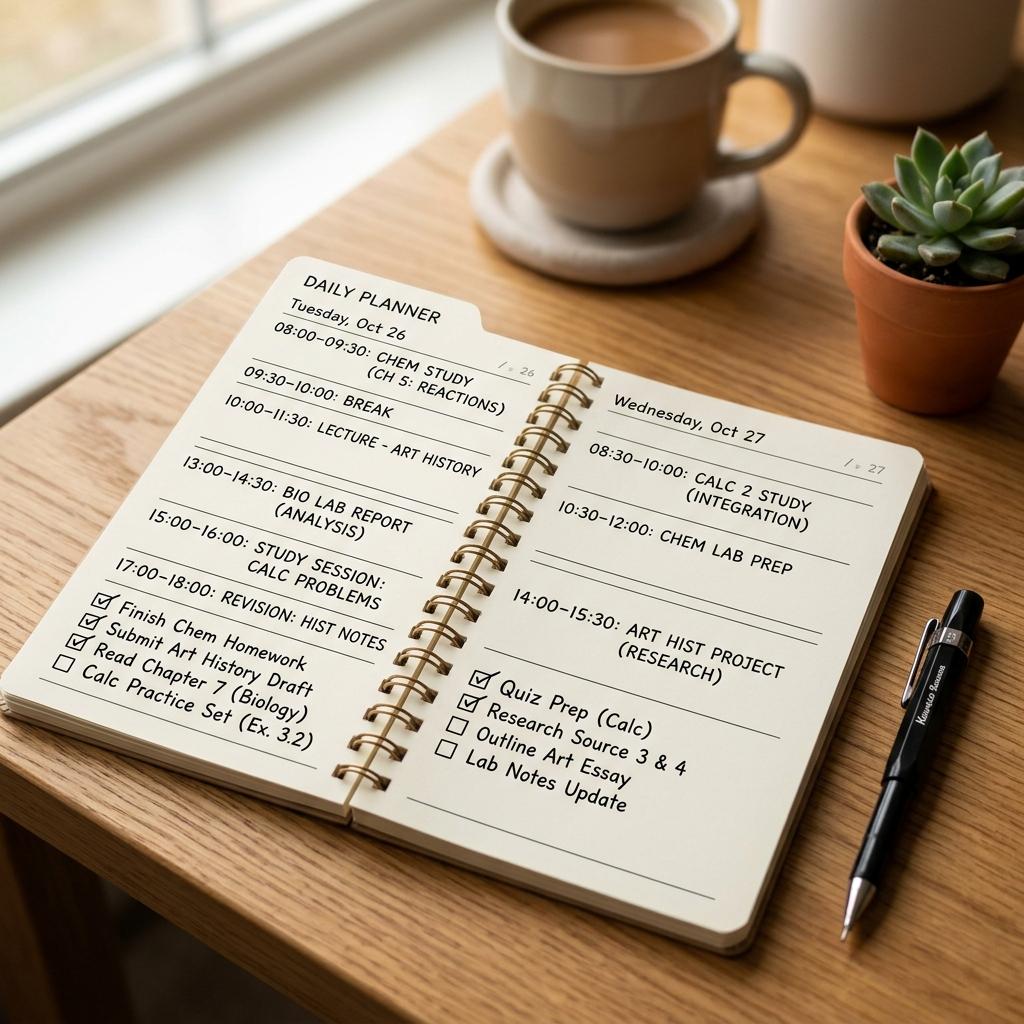
Most students study one subject for hours at a stretch, assuming focus equals progress. Interleaving - mixing related topics or problem types within a single session, rather than working through one type in a block - can improve long-term learning, particularly when you need to practice distinguishing between similar problem types or deciding which strategy to apply.
The reason is that switching between related problem types forces your brain to keep reloading and reselecting the right strategy, which is a form of retrieval practice in itself. A simple way to try this: instead of doing 20 calculus derivative problems in a row, mix in a few related integral problems so you have to identify which technique applies before you solve each one. It'll feel messier. That's the point.
Interleaving is especially useful in the weeks before a cumulative final, when you're reviewing several units at once anyway. Rather than dedicating one full day to unit one and the next full day to unit two, split each session across two or three related units. It will feel less organized than block studying, and your progress will feel slower in the moment - but when exam day arrives and questions jump between topics without warning, you'll already be practiced at making that switch.
7. Use Elaborative Interrogation
Where the Feynman Technique has you explain a whole concept from scratch, elaborative interrogation works on individual facts: every time you read or write down a claim, stop and ask yourself "why is this true?" or "how does this connect to what I already know?"
For example, instead of just noting that "mitochondria produce ATP," you'd pause and ask why that process matters for the rest of the cell, and how it connects to something you've already learned. Answering forces you to retrieve related knowledge and build connections between facts, rather than storing them as isolated statements you'll struggle to recall in a different context on the exam. It pairs well with flashcards and brain dumps. Anywhere you'd normally just note a fact, add a "why" or "how" question next to it.
If you don't have anyone around to test you out loud, recording yourself explaining a topic and listening back can help you notice unclear reasoning, skipped steps, or concepts you can't yet explain confidently. The key requirement is the same as every method on this list: you have to produce the information, not just consume it again.
How Long Does It Take to See Results?
You may notice immediately that retrieval practice exposes more gaps than rereading ever did. That's expected, not a sign you're doing it wrong. It's the desirable difficulty at work: the first time you try active recall or practice testing, it will feel harder and slower than rereading, precisely because you're no longer coasting on false familiarity.
Improvements in actual retention are best judged over repeated study sessions and later quizzes rather than after a single attempt. A useful way to check your progress: track which method you used each session, then compare how confident you felt with how you actually performed on related practice questions. Give any of these methods at least a week or two of consistent use before deciding whether it's working for you.
What Should I Do Instead of Rereading Before an Exam?
If an exam is close and your instinct is to do one more read-through, resist it. Instead, spend that time on a rapid self-test: close your notes and write down everything you remember about the topic, then check what you missed and focus only on those gaps.

Which Method Should You Use When?
| Situation | Best starting method |
|---|---|
| Memorizing definitions or vocabulary | Flashcards with spaced repetition |
| Understanding a difficult concept | Feynman Technique |
| Preparing for a cumulative final | Interleaving |
| Finding out what you've forgotten | Brain dump |
| Preparing for exam conditions | Timed practice questions |
| Turning existing notes into study material | Question conversion (Cornell-style) |
| Connecting isolated facts to what you already know | Elaborative interrogation |
Build a Study Routine That Replaces Rereading
You don't need to use all seven methods for every subject. A simple framework:
- After class or reading: Turn your notes into questions or flashcards instead of rereading them.
- A day or two later: Test yourself with active recall or practice questions, and use the Feynman Technique on anything conceptual.
- In the days before an exam: Review with spaced repetition and interleave topics instead of studying one subject in a single block.
The common thread across all seven techniques is retrieval - some form of pulling information out of your brain instead of putting it back in through your eyes. That single shift is responsible for most of the difference between students who feel like they studied and students who actually remember the material.
If you want to put this into practice without spending hours building flashcards or quizzes by hand, Cramd's AI flashcard generator turns your notes, PDFs, or slides into testable flashcards with spaced repetition built in - so you can skip straight to the part of studying that actually works. Try it free.