
You spent three hours going over your notes last night. You felt good - you could explain the material, you nodded along, everything made sense. Then you sit down for the quiz today and... nothing. The concepts are gone, or worse, half-remembered in a way that's actively wrong.
If this sounds familiar, you're not bad at studying. You're just fighting biology. Research on the forgetting curve shows memory can drop sharply soon after learning, especially when you never revisit the material. That's not a motivation problem - it's how memory works by default.
The good news: forgetting is predictable, and predictable problems have fixes. Below are seven research-backed ways to stop forgetting what you study, from how you review to how you sleep. None of them require more hours at your desk - just smarter ones.

Why You Forget What You Study (The Forgetting Curve, Explained)
What Ebbinghaus discovered about memory decay
In the 1880s, psychologist Hermann Ebbinghaus ran a simple but brutal experiment on himself: memorize nonsense syllables, then test his own recall at increasing intervals. What he found became one of the most replicated findings in psychology - memory doesn't decay gradually. It drops off quickly after learning, then levels out. Modern researchers have even published a replication and analysis of Ebbinghaus' forgetting curve, reinforcing the basic pattern: without review, memory tends to weaken fastest soon after learning.
It's not a "you" problem - it's how brains are wired
Your brain is built to forget. Holding onto every fact you've ever encountered would be exhausting and mostly useless, so your neural pathways weaken automatically unless something tells your brain "this matters, keep it." That signal comes from repeated use - recalling the information, applying it, or being tested on it. Passive review (rereading, highlighting, watching a lecture a second time) doesn't send that signal nearly as strongly. That's exactly why the seven strategies below focus on active engagement instead of passive review.
1. Use Active Recall Instead of Rereading
Rereading your notes feels productive because the material looks familiar. But familiarity isn't the same as memory - you're recognizing the words, not actually retrieving them from your own brain. That's the trap: recognition is easy, recall is hard, and hard is exactly what builds durable memory.
Why rereading feels productive but isn't
When you reread, your brain coasts on recognition cues from the page itself. Close the notes and try to explain the concept out loud or on a blank sheet, and you'll often find the knowledge isn't as solid as it felt a minute ago. That struggle to retrieve is uncomfortable, but it's also the mechanism that makes memories stick. This is the whole idea behind active recall - closing the book and forcing your brain to do the retrieval work itself, rather than letting your eyes do the "work" of skimming familiar text.
2. Space Out Your Review Sessions (Spaced Repetition)
Cramming everything into one long session might get you through tomorrow's quiz, but it does almost nothing for what you'll remember next month. Spacing your review sessions out over days and weeks works with your brain's forgetting curve instead of against it.
How spacing beats cramming
Reviewing material in short, spread-out sessions has been shown to improve long-term retention compared to massed, one-shot studying. The logic is simple: each time you let yourself almost forget something and then successfully recall it, that memory gets reinforced more strongly than if you'd reviewed it while it was still fresh. Spaced repetition is basically strategic forgetting, timed just right.
The 2-3-5-7 method as a simple starting framework
If you don't want to overthink your review schedule, a simple framework like the 2-3-5-7 revision method gives you a starting point: review material 2 days after you first learn it, then 3 days later, then 5, then 7. Each gap gets a little wider as the memory gets stronger, which mirrors exactly how spaced repetition is supposed to work.

3. Test Yourself Before You Feel Ready (The Testing Effect)
Quizzing yourself feels riskier than reviewing notes - you might get things wrong. That discomfort is precisely the point. Decades of memory research consistently show that retrieval practice beats restudying, a finding often called the testing effect.
Why quizzing yourself beats passive review
When you test yourself, you're forcing your brain to reconstruct information rather than just reread it. That reconstruction process is what strengthens the memory trace. Studies comparing self-testing to rereading and even concept mapping have repeatedly found that the group who tested themselves retained more, days and weeks later, than the group who kept restudying the same material. In one classic study on test-enhanced learning, students who took memory tests showed stronger long-term retention than students who repeatedly studied the same material.
Does self-testing really work better than studying notes?
Yes - and it's not close. Research going back over a century, and confirmed repeatedly in modern classroom studies, shows that actively retrieving information (via flashcards, practice questions, or just trying to explain a concept from memory) produces stronger, longer-lasting recall than rereading or highlighting. The effect holds across subjects, age groups, and test formats, from multiple choice to free recall. If you only change one study habit, make it this one: close the notes and quiz yourself before you feel ready.
4. Teach What You Learned to Someone Else (The Protege Effect)
Explaining a concept to a friend, a study group, or even your dog forces you to organize and retrieve information in a way that passive studying never will. This is sometimes called the protege effect, and researchers have found it holds up even without an audience.
Why explaining forces real retrieval
In one notable study, students who taught material from memory (no notes) performed just as well on a later test as students who did dedicated retrieval practice - and both groups beat students who simply restudied. The takeaway is that teaching works largely because it's a form of retrieval practice in disguise. You can't explain something you can't retrieve, so the act of teaching quietly does the same memory-strengthening work as self-testing.

5. Protect Your Sleep - It's Doing Memory Work Overnight
Studying harder and sleeping less might seem like a fair trade the night before an exam. It isn't. Sleep isn't downtime for your memory - it's active processing time.
How sleep consolidates what you studied
While you sleep, your brain replays and reorganizes what you learned that day, moving information from short-term storage into longer-term memory networks. This process, known as memory consolidation, is especially important for the kind of factual, declarative knowledge most students are trying to hold onto - dates, definitions, formulas, mechanisms. Sleep researchers have described this process in detail in reviews of sleep's role in memory, including how sleep helps stabilize and reorganize newly learned information. Cut the sleep short, and you're cutting off the process that was going to lock in everything you just studied.
Is pulling an all-nighter ever worth it?
Generally, no. Trading sleep for extra study hours undercuts the very consolidation process that turns your studying into lasting memory, and sleep-deprived brains are also worse at focus, problem-solving, and even forming new memories the next day. If you're deciding between an extra hour of review and an extra hour of sleep the night before an exam, the research consistently favors sleep - you can read more in our breakdown of whether all-nighters actually help before a test.
6. Turn Notes and Reading Into Flashcards
Flashcards are one of the simplest ways to combine active recall and spaced repetition into a single habit. The format itself forces retrieval - you see a question or prompt, and you have to produce the answer before you flip the card.
Why flashcards force retrieval instead of recognition
A textbook or slide deck lets you recognize the right answer sitting right there on the page. A flashcard doesn't give you that shortcut - you either know it or you don't, and that gap is exactly what drives learning. Making your own cards well matters too; a poorly written flashcard that just restates a definition won't push you nearly as hard as one built to test genuine understanding, which is why it's worth learning how to make flashcards that actually improve retention rather than just typing out your notes verbatim.
The catch is that manually building a full deck for every class is a huge time sink. That's where an ai flashcard generator like Cramd comes in - upload your notes, slides, or a PDF, and it turns them into ready-to-study flashcards with spaced repetition built in, so you spend your time actually recalling material instead of formatting index cards.
7. Build a Simple Review System You'll Actually Stick To
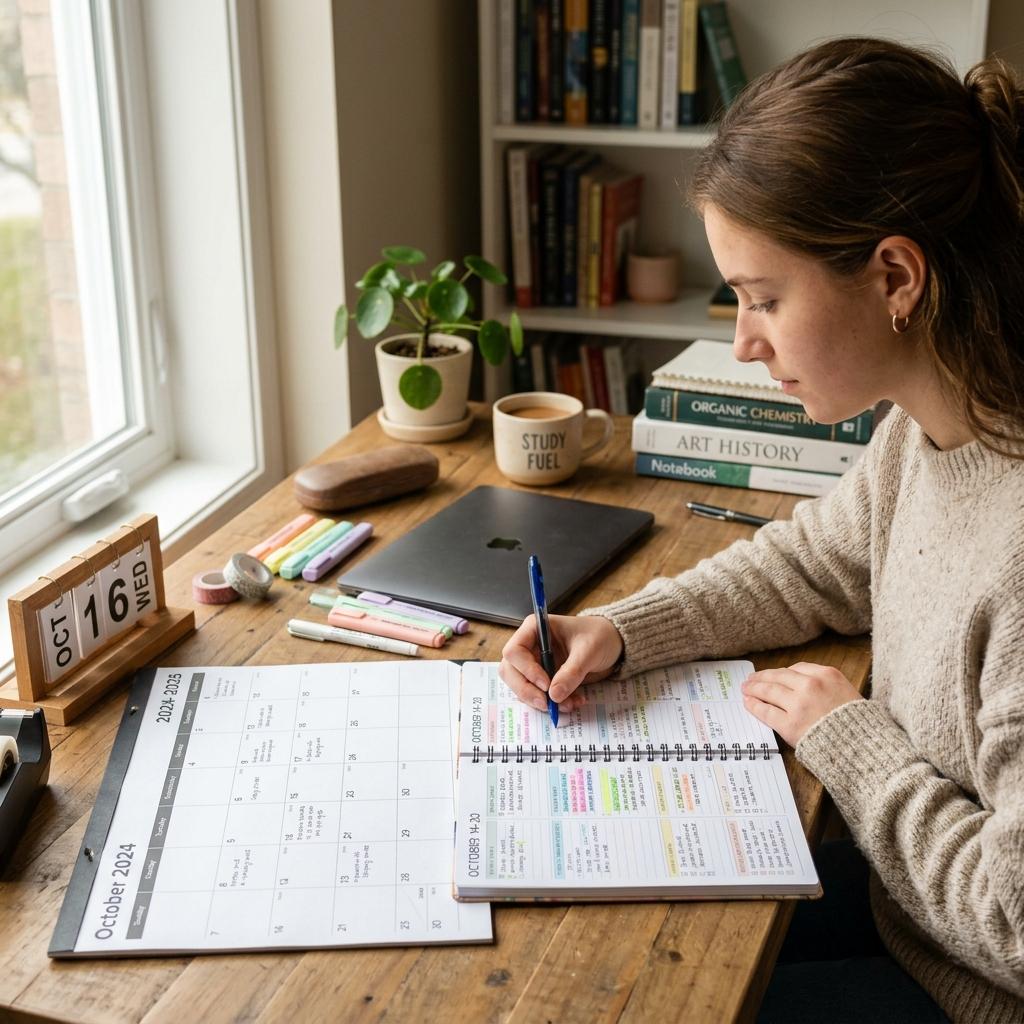
None of the techniques above matter much if you only use them once. The students who retain the most aren't the ones who study the hardest for one marathon session - they're the ones with a system simple enough to repeat every week.
Why consistency beats intensity
A short, consistent review habit - even 15-20 minutes a day - outperforms occasional long cram sessions because it keeps material inside the window where spaced repetition and active recall can do their work. Consistency also removes the dread factor; a quick daily review feels manageable in a way that a six-hour Sunday session never does.
How do I build a study routine that doesn't fall apart after a week?
Start smaller than feels necessary. Pick one short daily block, tie it to something you already do (right after breakfast, right before bed), and use active recall tools - flashcards, self-quizzing, brief teach-backs - instead of passive rereading. For a more complete framework on making the habit stick past week one, our guide to building effective study habits walks through how to design a routine around your actual schedule instead of an idealized one.
Final Thoughts
Forgetting what you study isn't a sign that something's wrong with you - it's the default setting of a normal brain. What changes the outcome is how you review: active recall instead of rereading, spaced sessions instead of cramming, self-testing instead of passive rereading, and enough sleep to let it all consolidate.
You don't need to overhaul your entire study routine overnight. Pick one or two of these techniques, build them into a simple weekly rhythm, and let consistency do the rest. And if you want to skip the busywork of building flashcards by hand, Cramd's AI flashcard generator turns your notes and PDFs into spaced-repetition-ready decks in seconds - try it free ->